Contact Us
 Directions
Pregnant workers and new parents

Are you pregnant or a new parent?
In Minnesota, you have legal protections to help keep you safe and healthy in the workplace. If you have questions, ask your employer or contact us. Most employers are willing to comply with laws that support their pregnant and lactating employees. If they are unwilling, we can help you.
1. Pregnancy at work
Staying healthy at work is important when you’re pregnant, both for you and your baby. If you are pregnant, you have the right to request the following accommodations without a health care provider’s note, and your employer must provide:
-
more frequent or longer restroom, food and water breaks;
-
seating; and
-
limits on lifting more than 20 pounds.
You have the right to request other workplace changes when you have been given advice from a health care provider or doula. This may require you to have a conversation with your employer about your request.
Other changes may include time off for prenatal care, temporary transfer to a less strenuous or hazardous job, modification in work schedule or tasks or a temporary leave of absence. There may be limited exceptions when your employer would not be required to provide these workplace changes; however, upon request, your employer is always required to provide more frequent or longer breaks, seating and limits on lifting more than 20 pounds.
Q: Do the pregnancy accommodation requirements apply to all employers?
A: Yes, employees have a right to reasonable pregnancy accommodations regardless of the size of the employer, with limited exceptions.
Q: Who should employees call if they believe they are being discriminated against because they are pregnant?
A: An employee who believes their employer has discriminated against them because they are pregnant may contact the Minnesota Department of Human Rights for possible pregnancy or sexual discrimination claims by visiting mn.gov/mdhr or calling 651-539-1100 or 800-657-3704.
2. Pregnancy and parental leave
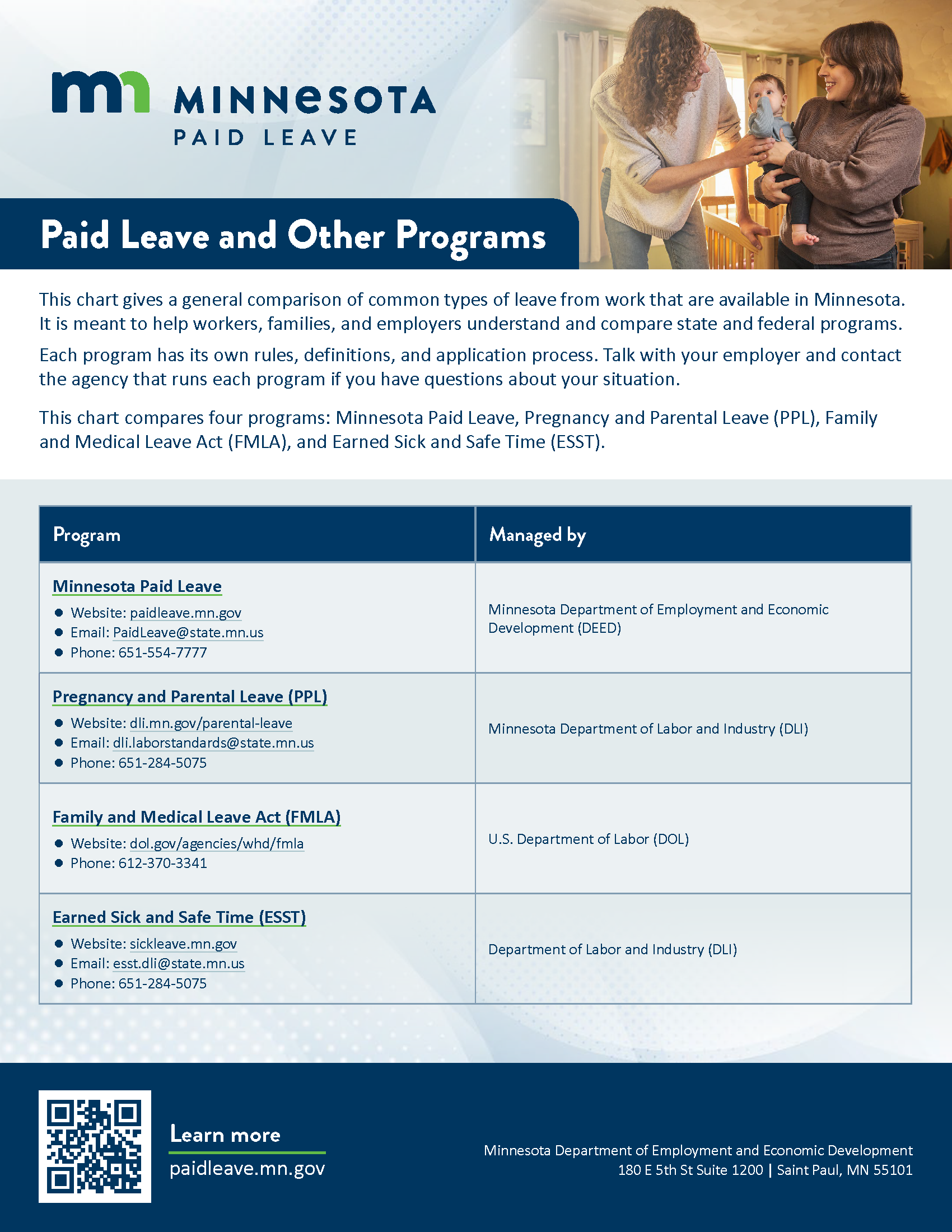
Minnesota’s Paid Leave program provides paid time off and job protections for most workers during pregnancy, after childbirth or to bond with a child. You may be able to take Paid Leave for:
-
pregnancy-related health needs;
-
childbirth and recovery;
-
bonding time as a birthing or non-birthing parent; and
-
bonding after adoption or foster care placement.
If you qualify, you can take up to 12 weeks for your own care and 12 weeks for bonding, with a combined total of up to 20 weeks. Bonding leave must be used within 12 months of the birth, adoption or foster placement. While on Paid Leave, you’ll receive part of your normal pay from the state.
Paid Leave may overlap with federal Family and Medical Leave Act (FMLA) protections. If you do not qualify for Paid Leave or FMLA, Minnesota law still provides 12 weeks of job-protected unpaid parental leave.
Q: Are employees who take pregnancy and parental leave entitled to the same job after returning from leave?
A: Yes, employees are entitled to return to their former positions or to positions of comparable duties, number of hours and pay. This is true whether someone is taking a leave under the Minnesota Paid Leave program or under the Minnesota Pregnancy and Parenting Leave law.
Q: Who should employees call if they believe they qualify for leave but are not being allowed to take the leave?
A: Employees who believe they are entitled to leave but are not receiving the leave should contact the Minnesota Department of Labor and Industry's Labor Standards Division at 651-284-5075 or 800-342-5354 to get more information about whether they qualify or to make a complaint. Employees should also call the Minnesota Paid Leave program at 651-556-7777 to determine if they are eligible for leave and partial wage replacement paid by the state of Minnesota.
Q: Is my employer required to continue providing me with my insurance while I am out on leave?
A: Yes. Employees on pregnancy and parental leave are entitled to the same coverage and employer contribution as if they were not on leave.
3. Expressing milk at work
Breastfeeding improves well-being and reduces health care costs. If you decide to express milk at work, your employer must provide:
-
break time to express milk without you losing compensation and regardless of whether the break unduly disrupts the operations of the employer; and
-
a clean, private and secure area to express milk that is not a bathroom, is shielded from view, is free of intrusion from coworkers and the public, is in close proximity to the work area, and has access to an electrical outlet.
There may be limited exceptions to these employer requirements.
Employees can choose when to express milk based on their needs, whether that means expressing milk during an existing paid break, during an existing unpaid break, such as a meal break, or during some other time.
Q: Can an employer require an employee to make up time for breaks taken to express milk at work?
A: No, an employer cannot reduce an employee’s compensation for time taken to express milk. While breaks to express milk may run concurrently with breaks already provided, including existing unpaid breaks, employers can’t reduce an employee's pay or require an employee to make up time used to express milk.
Q: Can an employer require an employee to use paid leave benefits such as sick time, vacation or paid time off for time used to express milk?
A: No, an employer may not reduce an employee's compensation for time used for the purpose of expressing milk. Compensation includes earned or accrued leave benefits.
Informing your employer
Need support in talking with your employer? Follow these tips.
Don’t wait. Begin the conversation early to help yourself and your employer.
Be positive. Approach the news as a win-win for both you and your employer.
Speak up. It’s OK to tell your employer your needs and rights.
Bring a coworker. You may want to consider bringing a coworker to join the discussion about your needs and rights.
Be informed. Share this website with your employer, human resources manager, coworkers or workplace advocates.
Know your rights. An employer may not retaliate, or take negative action, against an employee for asserting their legal rights.
If you have concerns about speaking directly with your employer, contact us for help.
Required employee notice
Employers must notify all employees of the rights of pregnant and lactating employees when hired, when an employee makes an inquiry about or requests parental leave and in an employee handbook if one is provided.
The notice must be provided in English and the primary language of the employee. The Minnesota Department of Labor and Industry (DLI) makes the required notice language available for employers in English and the five most common languages spoken in Minnesota.
Resources


English, Español, Hmoob and Soomaali. To receive copies of these brochures, complete this form.

WESA annual report (December 2025).

Contact us at dli.laborstandards@state.mn.us or 651-284-5075.